

Lot n° 16
Estimation :
15000 - 20000
EUR
Result without fees
Result
: 85 000EUR
Carstian LUYCKX (Antwerp 1623 - after 1670). - Lot 16
Carstian LUYCKX (Antwerp 1623 - after 1670).
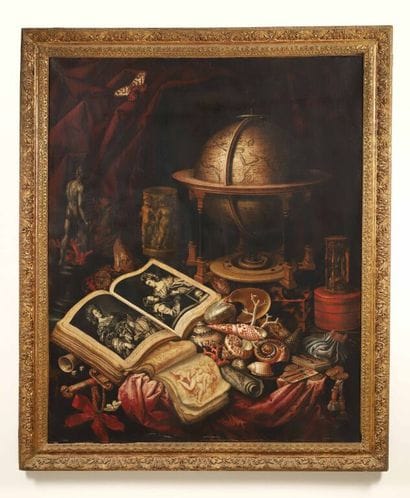
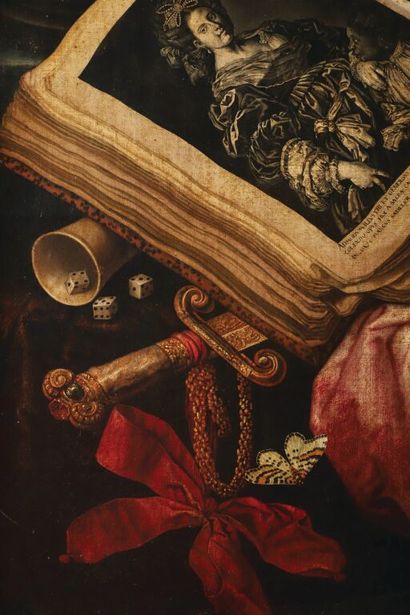
Vanitas with globe, collection of prints, shells and playing cards.
Canvas.
131.5 × 107.5 cm.
(Old restorations).
Our paintings can be compared with several late paintings by Carstian Luyckx, dated after he left Antwerp and settled in France (see the pair at the Szépmuvészeti Múzeum, Budapest). For a long time, his paintings were attributed to Simon Renard de Saint-André (Paris 1614-1677), on the basis of a signed painting that turned out to be a copy by Luyckx.
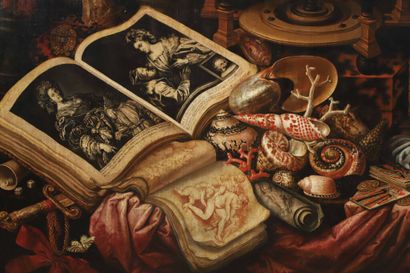
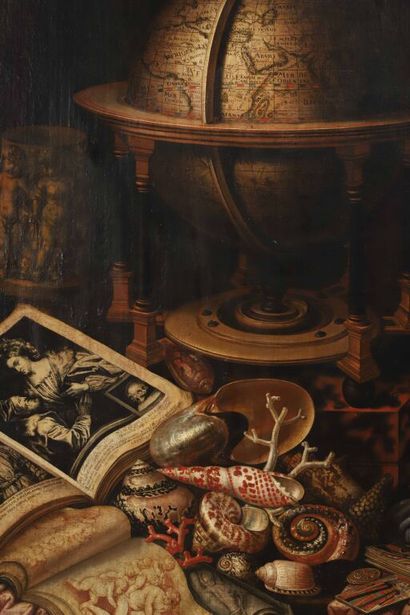
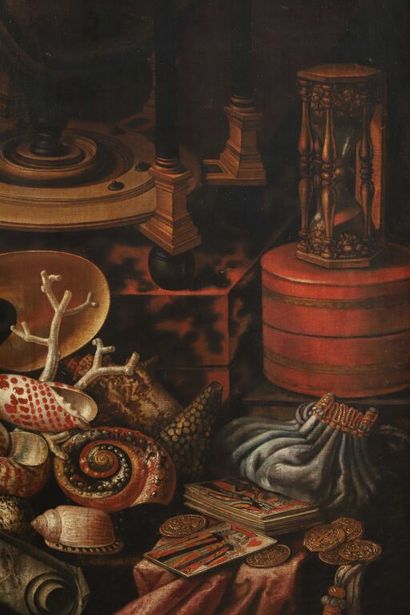
Around the traditional attributes of the vanity of knowledge, the globe and hourglass, the book of prints in the center is open to pages including the Portrait of Laura Dianti after Titian, engraved by Aegidius Sadeler and the Portrait of Titian and his daughter, formerly known as "Titian and mistress" engraved by Anthony van Dyck, in etching and burin. Below, a notebook of sanguine drawings, with Venus à la toilette. Various sculpted pieces and the presence of shells reflect the collecting mania of the French nobility and wealthy Dutch merchants for these rare and exotic treasures. We recognize a pearly nautilus, various sea snails such as a Burgo sarmaticus, a Cittarium pica, a Mitra papalis, a Voluta musica, a Nerita polita, a Lissachatina immaculata, and Conus mamorus. The coral branch embodies the divine protection Christ grants his faithful against the forces of evil.
The terrestrial globe, enthroned above a precious tortoise-shell box, is similar to those of the Blaeu dynasty of Dutch cartographers. The centerpieces of curiosity cabinets, they were considered scientific tools as much as works of art at the time.
The sword handle beneath the collection of prints and the purse overflowing with gold coins denounce the ephemeral pleasures of power, luxury and wealth. As for the cards and dice, "vanities" of earthly distractions, they suggest the dangers associated with the pleasure of gambling.
Finally, in the upper register, the moth, perhaps identified as a delicate, ephemeral Eucharia festiva, is a final symbol of the transience of life.
We would like to thank Fred Meijer for confirming the authenticity of our painting to Carstian Luyckx, via digital photograph, by email on February 1, 2025.
My orders
Sale information
Sales conditions
Return to catalogue