
Lot n° 71
Estimation :
200 - 300
EUR
Result without fees
Result
: 210EUR
[ANVERS]. Le Grand dictionnaire et trésor de trois langues F - Lot 71
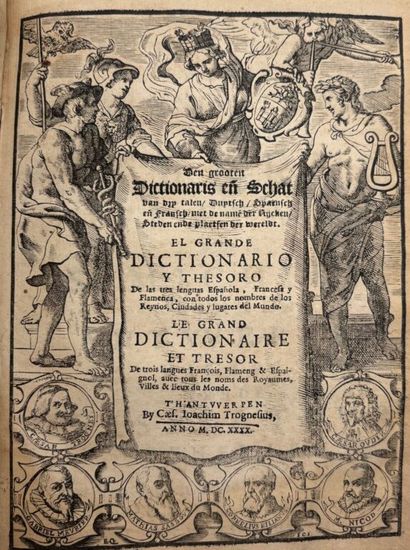
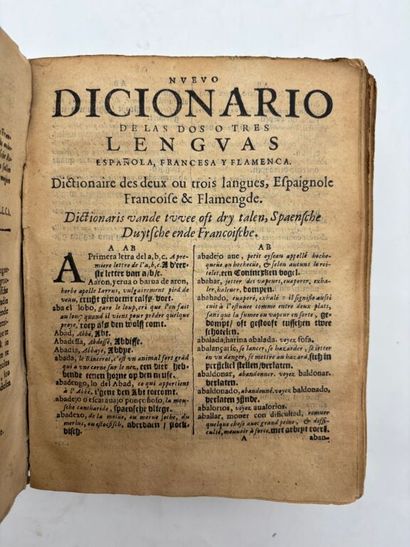
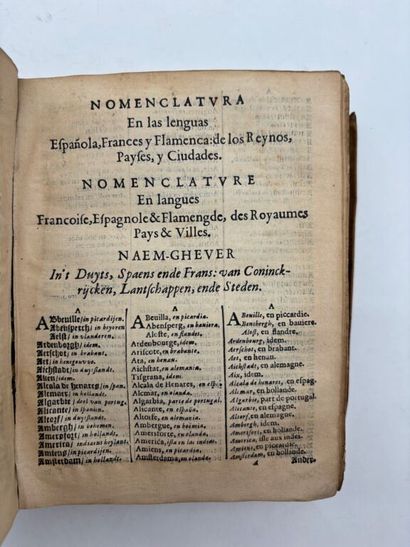
[ANVERS]. Le Grand dictionnaire et trésor de trois langues François, Flameng & Espaignol avec tous les noms des Royaumes, Villes, & lieux du monde - El Grande dictionaro y thesoro de las tres lengues Espagnola, Francesa y Flamenca, con todes los nombres de los Reynos, Ciudades y lugares del Mundo - Den grooten dictionaris en̄ schat van dry talen, Duytsch, Spaensch en̄ Fransch, met de namen der rijcken, steden ende plaetsen der wereldt.
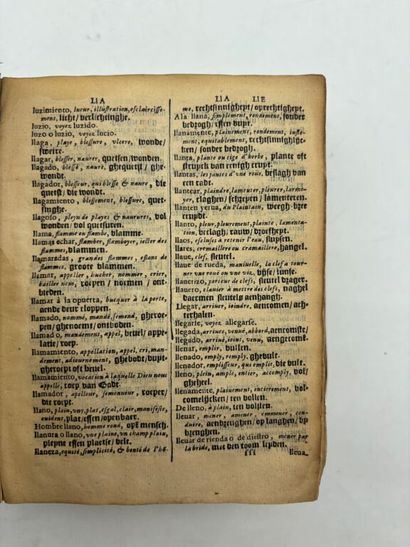
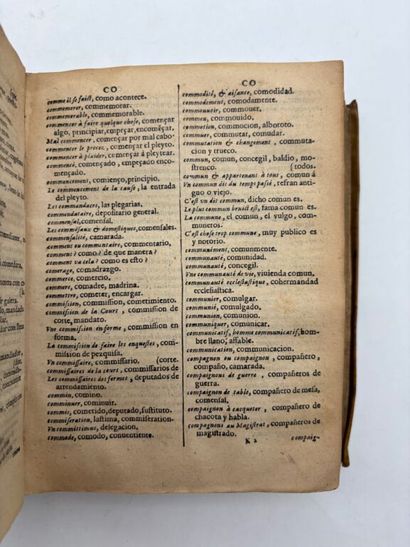
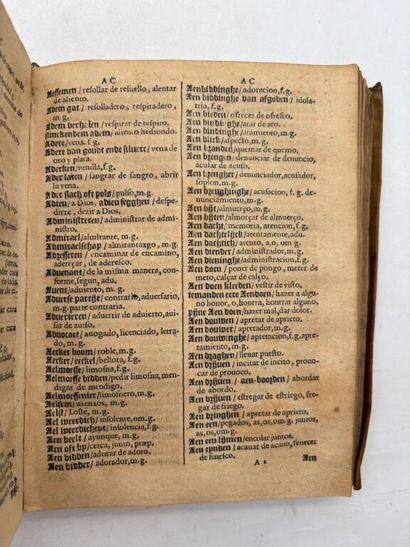
Rare copy, complete with all three parts of this trilingual Spanish, French and Flemish dictionary, printed in Antwerp by Trognaesius.
Antwerp, Caesar Joachim Trognesius, 1639-1640.
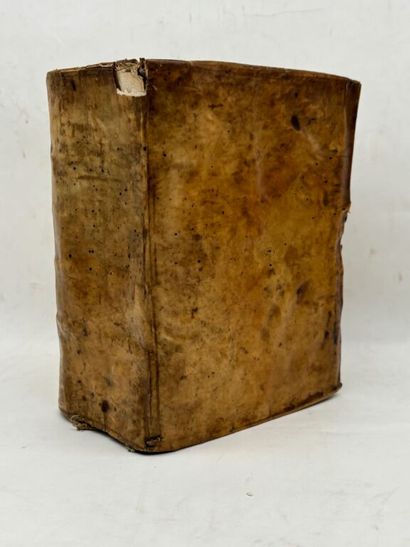
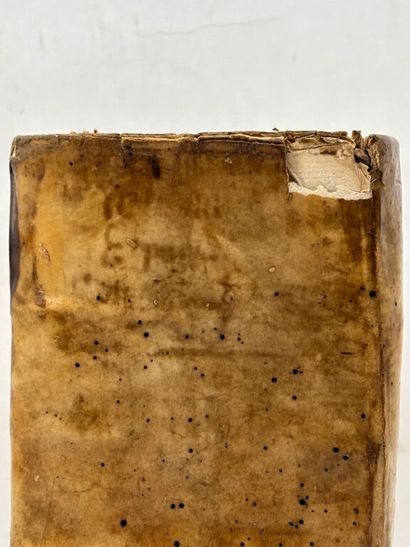
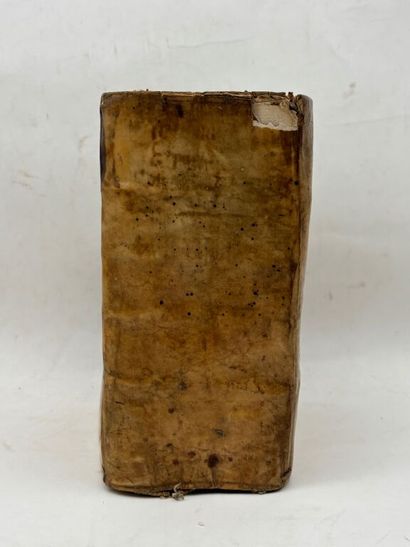
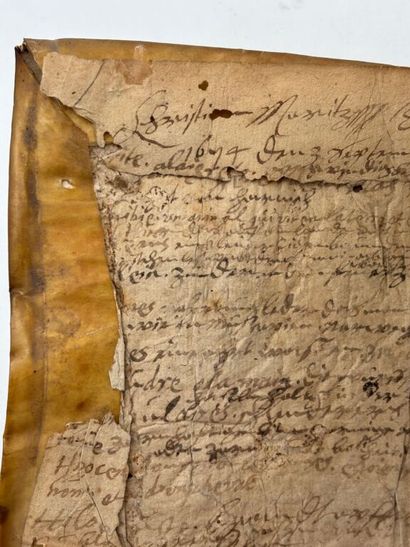
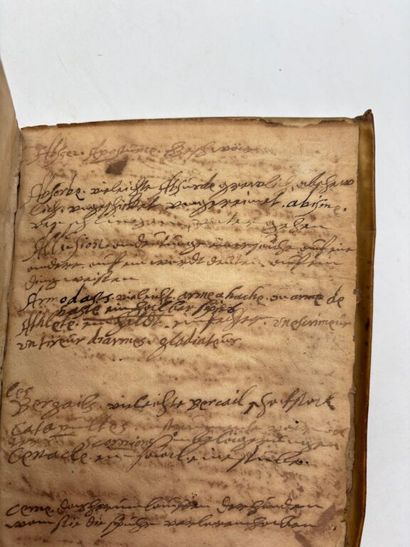
3 volumes in 1 in-4 (184 x 140 mm), full contemporary vellum, straight spine with handwritten title at head, reused paper endpapers.
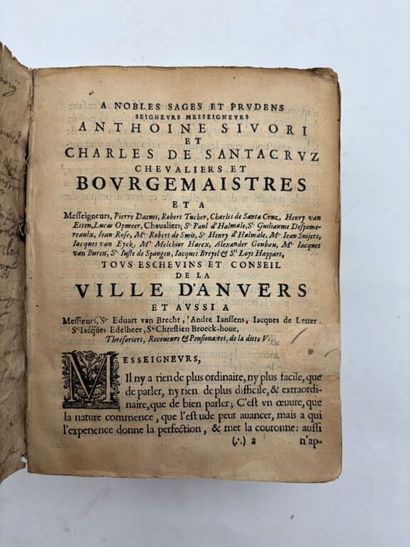
Unpaginated, approx. 1700 pages; three title-frontispieces.
Vellum rubbed, stains on boards and spine, headbands faded and leather missing from headcap, spine fragile, title page and one leaf detached, first title page missing, some freckling, spotting and dampstaining, some quires out of order.
First edition of this trilingual Spanish-French-Flemish dictionary, based on the lexicographical works of César Oudin (c. 1560 - 1625), Jean Nicod (c. 1530 - c. 1604), Cornelius Kiliann (c. 1529 - 1607), Mathias Sasbout, Gabriel Meurier (1530 - 1610) and Cæsar Joachim Trognesius (1590 - ??).
Until the Austrian conquest, Antwerp, a city of the arts, law and commerce, was one of Northern Europe's leading commercial and intellectual centers. It was with the aim of confirming this privileged position that the editor, Cæsar Joachim Trognesius, undertook this compilation. The choice of these three vulgar languages, rather than Latin or Greek, is explained as much by the position of Antwerp: close to France, which, although at war, nonetheless maintained strong links with the whole of the Netherlands, and within the Spanish Netherlands (Flemish being the country's own language), as by the strong tradition of publishing and language studies, characteristic of these wealthy Flemish and Dutch merchant towns.
It would seem, however, that only the first part, in which Spanish terms are translated into French and Flemish, is truly trilingual: the second part, in which French words are in turn translated, includes only an equivalence with Spanish, while the third part sees Flemish translated solely into Spanish.
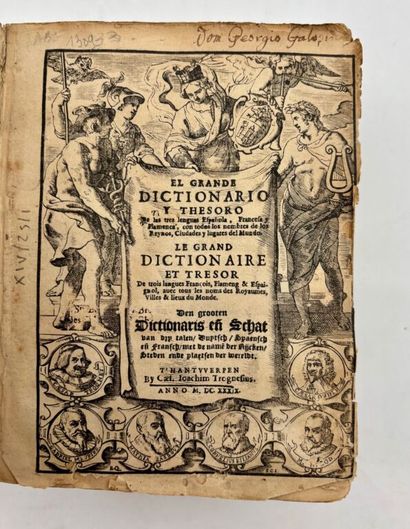
The title-frontispiece pages, identical except for the date (the first bears 1639, the other two 1640), bear the monograms E.Q. and I.C.I. The former can be attributed to Erasmus Quellinus. It is difficult to know whether the father or the son produced these pages, as the former died around 1620, while the latter was at the beginning of his career at the Guilde de Saint-Luc, where he was admitted in 1633-1634. The second monogram is too vague for any reliable hypothesis.
Surrounding the title, inscribed on a strong banner, are Apollo, on the right with his lyre, looking in the direction of Mercury, wearing his winged petascus and holding a caduceus, and helmeted Minerva, whose aegis has been reduced to a simple pectoral. Above them, holding the top of the sign in her right hand and the arms of the Marquisate of Antwerp in her left, a turreted allegory of the city turns her head towards the title and the six full-length cartouches, flown over by Fama sounding his two horns.
As for these cartouches, they feature each of the six contributors: Trognesius, the printer, directly responsible for this compilation and author of the two dedicatory epistles preceding the dictionaries; Gabriel Meurier, French lexicographer and author of a French-Flemish dictionary (published between 1574 and 1584); Mathias Sasbout, of whom little is known other than that he was the author of another French-Flemish dictionary published in 1579; Cornelius Kiliaan, author of a Dictionarium Tetraglotton in which Latin words are translated into Greek, French and Dutch; Jean Nicod, linguist and French ambassador to Portugal, author of French, bilingual French-Latin and trilingual French-Italian-Spanish dictionaries; César Oudin, lexicographer and secretary-interpreter for the foreign languages of Henri IV (from 1597), then Louis XIII, who was notably the first to translate Don Quixote into French. The medallions representing Nicod, Meurier and Sasbout seem to have been taken (with slight modifications) from another bilingual French-Flemish dictionary: "Le Grand dictionnaire François-Flamand" by Elcie Eduard Leon Mellema, first published in the late 16th century.
A good copy of this trilingual French-Flemish-Spanish dictionary, heir to a long tradition.
My orders
Sale information
Sales conditions
Return to catalogue